There was a time when buying something meant you owned it.
You bought a CD, and it was yours.
You bought a game cartridge, and it was yours.
You bought a movie on DVD, and nobody could remotely decide that you were no longer allowed to watch it.
You could lend it to a friend. You could sell it. You could put it in a box for ten years and rediscover it when you were older.
It was a simple relationship:
Money → Product → Ownership.
The internet has slowly replaced that relationship with something much more complicated.
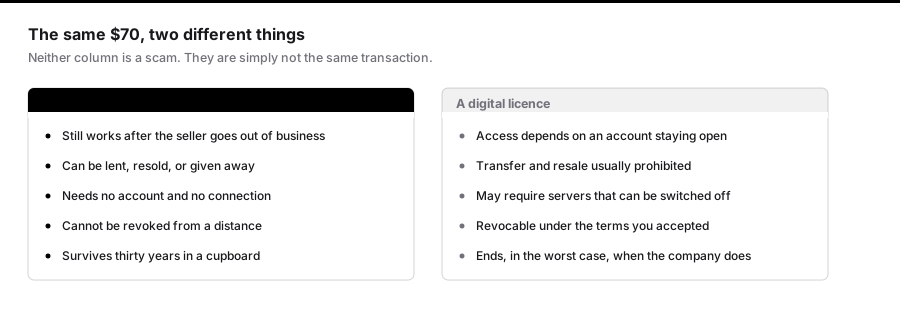
Today, you can spend $70 on a video game and not necessarily own the game itself.
You can pay for digital content and receive a license instead of property.
You can build years of photos, posts, messages and memories on a platform that you don't control.
You can buy digital goods inside a game that only exist as long as the game, account and infrastructure around them continue to exist.
And most of the time, we don't even notice.
Because the buttons still say:
BUY.
The receipts still say:
PURCHASE.
The price still looks exactly like a normal product.
But increasingly, what we're purchasing isn't ownership.
We're purchasing permission.
And the internet is becoming very good at selling us that permission.
Welcome to the Age of Digital Rental
The strange thing about digital products is that they don't behave like the physical products they replaced.
If you buy a physical book for $20, the seller generally doesn't get to wake up five years later and decide that you're no longer allowed to read it.
But digital products exist inside ecosystems controlled by somebody else.
Your game might require an account.
Your account might require an internet connection.
Your license might depend on a platform.
Your platform might depend on a company continuing to operate.
And the company can change the rules.
That's the fundamental shift.
The internet has turned ownership from a physical relationship into a service relationship.
You don't simply have the thing.
You have an account that has permission to access the thing.
And that distinction matters.
You Don't Own Your Steam Games
Take Steam.
For millions of PC gamers, Steam feels like a gigantic digital shelf.
You buy a game.
It appears in your library.
You download it.
You play it.
It feels like ownership.
But Valve's own Steam Subscriber Agreement is much more precise about the relationship.
Valve states that Steam content and services are "licensed, not sold" and that the license does not give the user title or ownership of the content. The agreement also says that using the content requires a Steam account and that some content may require the Steam client or an internet connection.
That's a pretty important distinction.
Imagine walking into a physical game store.
You hand over $60.
The cashier gives you a box.
You walk outside.
Then the cashier follows you into the parking lot and says:
"Technically, you don't own that. You have a license to use it under our terms."
You'd probably laugh.
Yet that's effectively the legal model behind many digital purchases.
The difference is that physical ownership gives you a tangible object.
Digital storefronts give you an entitlement attached to an account.
And we've collectively become comfortable treating that entitlement as ownership.
PlayStation Says It Too
This isn't just a Steam thing.
Sony's current PlayStation terms are remarkably explicit.
When you purchase digital content through the PlayStation Store, Sony says you are buying a personal license for private, non-commercial use. That license is generally not transferable, and Sony explicitly says that this means you can use the product according to the license but do not own the product.
The terms go further.
PlayStation says that digital content is generally licensed on a non-exclusive and revocable basis.
It also says that deleting or closing an account may result in losing access to purchased content. In some cases, products can also be linked to third-party accounts, creating another dependency.
There is something almost surreal about this.
The storefront can present something to you as a purchase.
You pay the full price.
You receive a receipt.
The game sits permanently inside your library.
And underneath all of that, the legal relationship is still a license.
That doesn't automatically make digital purchasing a scam.
But it does mean the word buy doesn't necessarily mean what people instinctively think it means.
The $70 Game That Can Disappear
Imagine buying a $70 game.
You download it.
You play it for 100 hours.
Five years pass.
The publisher shuts down its servers.
The company discontinues the game.
A required online service disappears.
Your account becomes inaccessible.
The game is removed from the store.
Or the platform itself eventually disappears.
Suddenly, the thing you thought you purchased is dependent on infrastructure you don't control.
Not every game works this way.
Many games remain playable offline after servers disappear, and some publishers provide patches or preservation measures.
But the broader vulnerability is real.
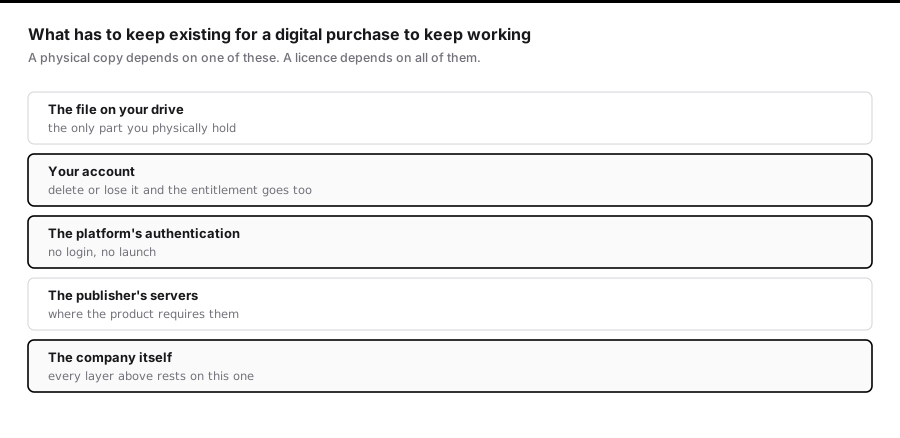
Digital products can depend on systems outside the user's control.
And the internet itself is much less permanent than we like to imagine.
The Internet Has a Memory Problem
We have more storage than humanity has ever had.
We can preserve enormous amounts of information.
We can make perfect digital copies.
We can access information from almost anywhere on Earth.
And yet things disappear constantly.
A forum closes.
A company goes bankrupt.
A server gets shut down.
A social network changes its policies.
An API disappears.
A domain expires.
A creator deletes their account.
A website redesign removes ten years of articles.
And suddenly something that millions of people relied on is gone.
Research from the Pew Research Center demonstrates just how severe this problem is. Pew examined almost one million webpages collected through Common Crawl between 2013 and 2023.
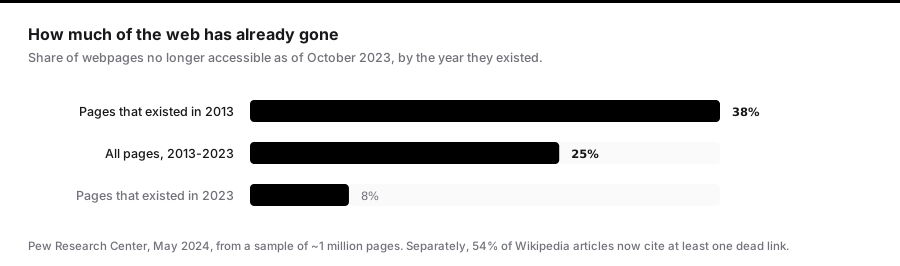
It found that 25% of webpages that existed at some point during that period were no longer accessible by October 2023. For pages from 2013 specifically, the number was 38%.
Think about that.
Almost four out of every ten pages that existed in 2013 were inaccessible a decade later.
It gets worse for anything built on citations: 54% of Wikipedia articles now contain at least one reference pointing at a page that no longer exists. The footnotes of the world's most-read reference work are quietly rotting.
The internet is enormous.
But enormous does not mean permanent.
"But I Paid for It."
This is probably the biggest psychological trick of digital commerce.
We use the word buy for things that don't necessarily behave like purchases.
Buy a movie.
Buy a game.
Buy an ebook.
Buy an app.
Buy DLC.
Buy virtual currency.
Buy cloud storage.
Buy a subscription.
Buy a digital upgrade.
The word "buy" makes the transaction feel permanent.
But the actual relationship can be completely different.
A physical purchase traditionally gives you a transferable object.
A digital purchase can instead give you a set of permissions attached to an account.
And those permissions can come with restrictions.
You might not be allowed to resell the item.
You might not be allowed to transfer it.
You might not be allowed to modify it.
You might need a particular device.
You might need an internet connection.
You might need an active account.
You might need another company's account linked to yours.
And sometimes, you might simply need the company to keep the lights on.
Your Game Library Isn't Really a Library
Think about the word library.
A library is somewhere you go to access things.
But modern digital game libraries are fundamentally different.
Your Steam library.
Your PlayStation library.
Your Xbox library.
They look like shelves.
But underneath, they're databases of permissions and account entitlements.
That distinction becomes especially important when an account is lost.
PlayStation's terms explicitly warn that closing or deleting an account can result in losing access to purchased content. They also warn that linking a third-party account can create another dependency.
The modern digital library therefore has a strange property:
You can fill it without physically possessing anything inside it.
And Then There Are Digital Items
Games have taken this even further.
You can buy skins, coins, weapons, characters, emotes, battle passes, vehicles, cosmetic items and virtual currency.
These things can feel like possessions.
But they're usually tied completely to the ecosystem in which they exist.
PlayStation's software terms, for example, describe digital content as licensed rather than transferred as property, and impose restrictions on transferring, reselling and modifying content.
So imagine spending $20 on a digital skin.
You don't have a physical skin sitting somewhere.
You have an entitlement recorded by a server.
The skin cannot exist independently.
You can't put it in a box.
You can't necessarily move it to another game.
You can't necessarily sell it.
You can't necessarily transfer it.
And if the game disappears, the thing you purchased may disappear with it.
You bought something that only exists because another system recognizes that you have permission to use it.
That's a very different concept from owning a physical object.
Subscriptions Are the Honest Version
At least subscriptions are honest about what they are.
Netflix doesn't pretend you own Netflix.
Spotify doesn't pretend you own Spotify.
Game Pass doesn't pretend you're purchasing every game permanently.
You pay for access.
You stop paying.
The access ends.
That's a rental model, and everybody understands it.
The strange part is that the rental model has spread into places where we still use the language of ownership.
Software subscriptions are the obvious example. Creative tools. Office software. Cloud storage. Productivity applications. Development tools. AI services.
The economics make perfect sense for companies.
Instead of selling software once for $100, a company can charge $10 every month. One customer can generate hundreds of dollars over their lifetime.
From the company's perspective, that's predictable revenue.
From the consumer's perspective, it changes the economics completely.
You aren't simply buying a tool.
You're maintaining access to a tool.
The Subscription Trap
Subscriptions aren't inherently bad.
But they can create a different kind of consumer problem.
When a purchase is one-time, the transaction ends.
When a subscription is involved, the transaction becomes a relationship.
And companies have an incentive to keep that relationship alive.
This is one reason regulators have become increasingly interested in recurring billing practices.
In 2024, the U.S. Federal Trade Commission announced a final "click-to-cancel" rule intended to make cancellation of recurring subscriptions easier and to require clearer disclosures and consent around negative-option billing. The FTC said it had been receiving thousands of complaints about negative-option and recurring-subscription practices each year.
The important point isn't that every subscription company is trying to trap customers.
The point is that recurring billing creates an economic incentive that simply doesn't exist with a one-time purchase.
A physical product doesn't charge you again because you forgot about it.
A subscription can.
The Cloud Is Another Rental
Then there's the cloud.
This might be the biggest example of all.
We used to keep our files on hard drives.
Your photos were on your computer.
Your music was on your computer.
Your documents were on your computer.
Your backups were on physical drives.
Now we increasingly store everything on somebody else's computers.
We call it:
The cloud.
But there is nothing magical about the cloud.
It's infrastructure owned and operated by somebody else.
And you're paying for access to it.
That doesn't make cloud storage bad. It's incredibly useful.
But it creates dependency.
If your cloud account disappears, your files aren't sitting in a drawer at home.
If the service goes down, you wait.
If your account is compromised, you have a problem.
If pricing changes, you decide whether to pay more or move your data.
Your data may be yours in one sense.
But your access to it is mediated by another company.
Again:
You don't necessarily own the infrastructure that holds your digital life.
Social Media Is Rented Land
Then we reach something most people don't even think of as a product:
your identity.
For years, people have built digital identities on social networks.
Your followers are there.
Your photos are there.
Your messages are there.
Your communities are there.
Your reputation is there.
Your content is there.
Your memories are there.
And yet you don't own the platform.
You don't control its servers.
You don't control its recommendation algorithm.
You don't control its moderation system.
You don't control whether its policies change.
And you certainly don't control whether the company continues operating.
You've effectively built part of your digital life on somebody else's infrastructure.
We Built Our Lives on Rented Land
This is probably the simplest way to understand the modern internet.
Imagine a giant city where almost every building is rented.
You can decorate your apartment. Invite friends over. Build a business inside it. Put pictures on the walls. Spend twenty years there. Become famous there.
But the landlord controls the building.
They can change the rules.
They can change the rent.
They can renovate it.
And in extreme cases, they can close it.
That's the internet.
Your community lives on a platform.
Your files live in the cloud.
Your software lives behind a subscription.
Your games live inside an account.
Your digital purchases live inside a storefront.
Your audience lives on somebody else's servers.
The internet isn't eliminating ownership completely.
It's moving the center of control away from the user.
The Death of the Physical Copy
There is another reason this matters.
Physical media is increasingly disappearing.
That trend makes economic sense. Discs cost money to manufacture. They require packaging. They need shipping. They occupy warehouse space. Retailers take a cut.
Digital distribution is faster and cheaper.
But physical media has an underrated feature:
independence.
A disc doesn't need the original storefront to remain online.
A cartridge doesn't need a login screen.
A Blu-ray doesn't need a monthly subscription.
A book doesn't need an API.
A physical object can survive the company that produced it.
That's incredibly important for preservation.
The Law Has Started to Notice
And the debate around digital ownership is no longer merely philosophical. It is now written into statute.
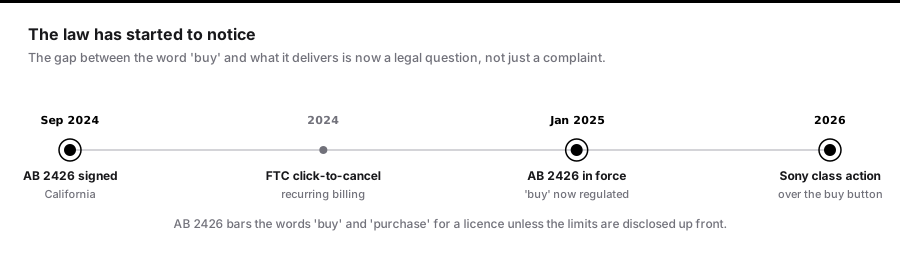
In September 2024, California signed AB 2426 into law, and it took effect on 1 January 2025. It does something remarkably direct: it makes it unlawful to advertise a digital good using the words "buy", "purchase", or any other term a reasonable person would take to confer unrestricted ownership — unless the seller either obtains an affirmative acknowledgement that the customer is receiving a revocable licence, or provides a clear, plain-language statement to that effect along with a link to the full terms, before the sale.
It covers digital films, music, books, code, applications and games. Violations carry civil penalties of up to $2,500 each.
In other words: the exact gap this article is about — between the word on the button and the thing you receive — is now a matter of law in the largest state economy in the United States.
And it is being tested. In 2026, a proposed class action over the PlayStation Store's "buy" and "purchase" labelling alleges that Sony sells revocable licences without the disclosures that law requires. Sony's reported position is that "reasonable consumers would not be misled", and it has moved to push the case into individual arbitration rather than court.
Whatever ultimately happens there, the underlying question is the interesting one:
When a storefront says "Buy," what exactly has the customer bought?
The Bizarre Thing About Digital Ownership
Digital technology was supposed to make ownership better.
Instead, in some ways, it made ownership weaker.
Think about what computers could have given us. Perfect copies. Cheap storage. Instant distribution. Global access. No physical degradation. No scratched discs. No broken cartridges. No shipping. No manufacturing shortages.
Digital products could have created one of the greatest ownership systems humanity had ever seen.
Instead, we built ecosystems around them.
And ecosystems come with gatekeepers.
The company controls the store.
The company controls the servers.
The company controls authentication.
The company controls the account.
The company controls the rules.
And suddenly the consumer owns the least important part:
the payment receipt.
But Isn't Piracy Part of the Reason?
Absolutely.
This is where the conversation gets uncomfortable for the other side too.
Companies didn't wake up one morning and decide they wanted to make everything annoying.
Digital products are incredibly easy to copy.
If I own a physical book, I can't instantly create a perfect copy and distribute it to ten million people.
Digital files can be copied. Movies can be copied. Music can be copied. Games can be copied. Software can be copied.
Companies therefore built DRM, authentication, accounts and online services to protect intellectual property.
Some of these systems are useful. Some are necessary. Some are arguably excessive.
But the underlying problem is real.
Digital technology destroyed much of the scarcity that physical products relied upon.
So companies built systems around controlled access.
That's the trade-off.
The Problem With Permanent Permission
Here's the philosophical issue.
A product you own can outlive its manufacturer.
A license may not.
That's an enormous difference.
If the company that manufactured your chair disappears tomorrow, you still have a chair.
If the company that made your physical book disappears, you still have a book.
If the company that produced your old game cartridge disappears, you may still be able to play it.
But if your digital product depends on a server, account or authentication system, the product can become unusable when the surrounding ecosystem disappears.
The thing hasn't physically broken.
The permission structure has.
That is a completely different form of decay.
We're Also Losing the Ability to Resell Things
Physical ownership comes with another powerful concept:
secondary markets.
You can sell your old game. Trade your books. Sell your DVDs. Give your old console to your cousin. Buy something second-hand.
Digital ecosystems often restrict those possibilities.
PlayStation's terms, for example, describe digital purchases as personal licenses and generally prohibit transferring those licenses except where applicable law requires otherwise.
That is convenient for companies. Every new customer remains a new transaction.
But it changes the economics of ownership.
A physical product can have a lifecycle:
New → Used → Resold → Used again → Resold again.
A digital license often looks more like:
New → Account → Stays there.
The resale market disappears.
And with it disappears one of the most useful properties of ownership: the ability to recover some of your money by passing the thing to someone else.
The Preservation Problem
There's an even bigger issue hiding underneath all of this.
History.
What happens when a generation's culture becomes dependent on companies maintaining access?
Imagine someone in 2075 trying to study games from 2025.
Some games will survive. Some will be archived. Some will be emulated. Some will have physical copies.
But others could disappear.
Servers gone. Authentication gone. Licenses expired. Companies bankrupt. Stores closed. Accounts inaccessible. Files removed.
The web already gives us a warning. Pew's research found that 25% of sampled webpages from 2013–2023 were inaccessible by 2023, with 38% of pages from 2013 no longer accessible.
Twenty years isn't very long.
And we're talking about a medium that many people assume is permanent.
The Internet Is Not a Library
This might be the biggest misconception.
People often talk about the internet like it is humanity's giant library.
It isn't.
It's closer to a giant shopping mall built on leased land.
Things appear. Things disappear. Businesses come and go. Rules change. Servers shut down. URLs die.
And unless somebody deliberately preserves something, there is no guarantee it will still exist.
The internet remembers a lot.
But it also forgets extremely efficiently.
So What Should We Do?
The answer isn't to destroy subscriptions.
It isn't to demand that every digital product behave exactly like a physical product.
And it isn't to pretend digital licensing has no legitimate purpose.
The answer is simpler:
Consumers should know what they're buying.
If something is a subscription, call it a subscription.
If something is temporary access, explain that.
If something is a license, make that obvious.
If a game requires permanent online authentication, tell people before they buy it.
If virtual items disappear when a game shuts down, say so.
If deleting an account can destroy access to years of purchases, make that obvious.
If a product cannot be transferred or resold, explain that clearly.
Don't put a giant BUY NOW button on the screen and bury the actual relationship inside pages of legal text.
Because legally, those terms might be clear.
But psychologically?
They're not.
That is, almost word for word, what California decided too. AB 2426 doesn't ban licensing. It doesn't force anyone to sell property instead. It just says that if you are selling permission, you have to say so before you take the money.
Maybe We Don't Need Ownership of Everything
There is another side to this.
Maybe the future really is going to be about access.
And maybe that's okay.
I don't need to own every movie I watch.
I don't need to own every song I hear.
I don't need to own every software tool I use.
I don't need a physical copy of every game I play.
Convenience matters. Price matters. Access matters.
Streaming is one of the greatest conveniences the internet has created. Cloud computing is incredible. Digital distribution has made enormous libraries accessible to people who could never have afforded them physically.
The problem isn't access.
The problem is confusing access with ownership.
Those are two different things.
And consumers should be able to choose between them.
The Future Might Have Two Internet Economies
I think we're heading toward a split.
The Rental Internet
Subscriptions. Cloud services. Streaming. Game passes. SaaS. Digital licenses. Account-based ecosystems. Virtual goods. Platforms.
Everything convenient. Everything connected. Everything dependent.
The Ownership Internet
Local files. Physical media. Self-hosted services. Open-source software. Offline games. DRM-free stores. Personal backups. Independent websites.
Things that can survive without a single company keeping the servers alive.
Neither side is going to completely win.
People love convenience too much.
But there will probably be a growing group of people who deliberately choose products they can actually keep.
Not because they're nostalgic.
Because they understand the difference.
One Question to Ask Before Buying Anything
Not:
"How much does it cost?"
But:
"What exactly am I getting?"
Do I get a file? A physical object? A permanent license? A temporary license? An account entitlement? Access to a server? A subscription? A service? A product that stops working when a company shuts down?
Those distinctions are becoming more important every year.
Because $70 can buy you very different things.
It can buy you a physical object that sits on your shelf for decades.
Or it can buy you a permission that exists inside somebody else's ecosystem.
The price might be identical.
The ownership isn't.
The Internet Isn't Becoming a Rental Overnight
That's the important part.
We're not going to wake up tomorrow and discover that everything we own has disappeared.
The change is much quieter.
A little subscription here.
A digital license there.
A required account.
An online-only game.
A cloud-only application.
A platform-exclusive purchase.
A virtual item that can't leave its game.
A website that disappears.
A service that shuts down.
None of these things individually destroys ownership.
But together, they create a new default.
A world where access is normal and ownership is optional.
And perhaps the strangest part is that we willingly participated.
Because it's convenient. Because it's cheap. Because it works. Because nobody wants to carry around a shelf full of DVDs anymore. Because downloading a game is easier than driving to a store. Because streaming is easier than buying a Blu-ray. Because having terabytes of cloud storage is easier than managing your own server.
Convenience won.
And convenience has a price.
The Real Cost of the Rental Internet
The cost isn't always money.
Sometimes it's control. Sometimes it's permanence. Sometimes it's privacy. Sometimes it's portability. Sometimes it's preservation.
Sometimes it's the ability to say:
"This is mine."
That sentence used to be incredibly simple.
Now it requires a surprisingly complicated answer.
Do you own the hardware?
Do you own the software?
Do you own the account?
Do you own the license?
Can you transfer it?
Can you resell it?
Can you use it offline?
Can you back it up?
Can you access it if the company disappears?
Can you access it if your account gets banned?
Can you move it somewhere else?
If the answer to most of those questions is no, then maybe you don't own the thing in the way you thought you did.
Maybe you bought access.
And access is not the same thing as ownership.
The Internet Was Supposed to Give Us Freedom
That might be the biggest irony of all.
The internet was built around copying information. It made distribution almost free. It allowed ordinary people to publish. It connected communities that never would have existed physically. It gave us unprecedented access to knowledge, entertainment and communication.
And yet the commercial internet increasingly works through controlled platforms.
You don't own the network.
You don't own the storefront.
You don't own the server.
You don't own the algorithm.
You don't necessarily own the digital product.
You rent the space. You rent the access. You rent the tools.
And sometimes, you even rent your audience.
The internet gave us more digital freedom than any generation before us.
But if we're not careful, we could spend that freedom building our entire lives inside systems that somebody else controls.
Maybe We Should Keep a Few Things
Keep the files you care about.
Back up your photos.
Download things that are legitimately downloadable.
Buy DRM-free when practical.
Keep physical copies of the things you genuinely care about.
Support companies that respect preservation.
Support creators directly.
Don't assume that something online will exist forever.
And most importantly:
Know the difference between buying something and buying access to something.
Because the internet has blurred that line almost completely.
And once you see it, you start noticing it everywhere.
That monthly application. That $70 digital game. That streaming service. That cloud drive. That account you've spent ten years building. That virtual item you paid real money for. That website you assumed would always exist.
They're all part of the same transition.
The transition from an internet where we kept things to an internet where we access things.
Maybe that's the future.
Maybe it's even a better future.
But if that's where we're going, we should at least be honest about what we're giving up.
Because the internet isn't necessarily taking everything away from us.
It's doing something much more subtle.
It's teaching us to stop asking whether we own something.
And to be satisfied that we can use it.
For now.
Sources & Further Reading
- Steam Subscriber Agreement — Valve's own terms, stating that Steam content is licensed and not sold.
- PlayStation Terms of Service — Sony's terms covering digital purchases, licences, resale and account access.
- California AB 2426 — Consumer protection: false advertising: digital goods — the statute restricting the words "buy" and "purchase" for licensed digital goods.
- Pew Research Center — When Online Content Disappears — the link-rot research behind the figures in this article.
- FTC — Click-to-Cancel Rule — the U.S. rule on recurring subscriptions and cancellation.
- Tom's Hardware — Sony argues "reasonable consumers would not be misled" — reporting on the 2026 PlayStation Store class action over the buy button.