A few years ago, if someone told you that most of the internet was run by bots talking to other bots, you would probably assume they had spent a little too much time reading conspiracy theories at 3 AM.
And to be fair, the Dead Internet Theory has always sounded pretty ridiculous.
The basic idea is that a huge portion of what we see online isn't created by real people anymore. Instead, bots, algorithms, AI-generated content, and automated systems are creating and amplifying content while humans mostly watch from the sidelines.
For a long time, this was easy to dismiss.
Then AI happened.
The Internet Feels Different Now
Think about the last time you searched for something.
You probably found a page that looked like hundreds of other pages. A familiar layout. A headline carefully designed to answer your question. A long introduction before getting to the point.
Maybe the article was useful.
Maybe it wasn't.
But increasingly, there's another question worth asking:
Was anyone actually sitting there writing it?
Today, an AI can generate hundreds of articles in minutes. Another system can automatically publish them. Bots can share those articles across social media. Other bots can comment underneath them.
And somewhere in the middle of all of this, an actual human might click the link.
That's the weird part.
We're not necessarily living on a "dead internet." But we're definitely living on an internet where it's becoming harder to tell who—or what—is behind the screen.
Bots Have Always Been Here
This isn't entirely new.
Spam emails have existed for decades. Fake social media accounts aren't exactly a recent invention either. Automated comments have been annoying people since the early days of blogging.
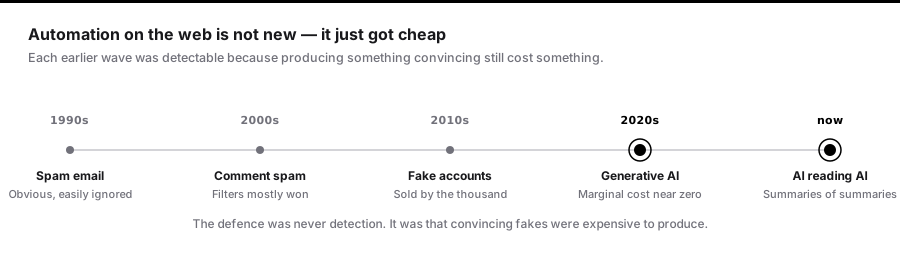
The difference is that bots used to be relatively easy to spot.
They had strange usernames. Broken grammar. Random profile pictures. Comments like:
"Great article! Very informative website. Please visit my profile."
Nobody was fooled.
Now things are changing.
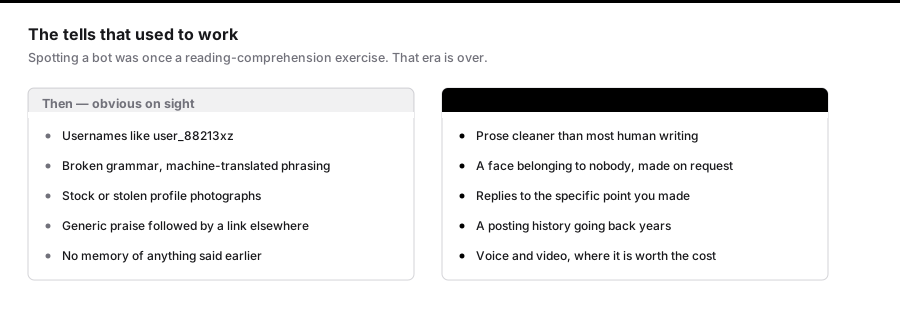
AI can write better than most spam bots ever could. It can imitate writing styles, respond to comments, generate profile pictures, create videos, and even maintain conversations.
The internet's fake people are getting better at pretending to be people.
AI Content Is Everywhere
The strange thing about AI-generated content isn't that it exists.
Of course it exists. The technology is available to everyone.
The strange part is how quickly it has become normal.
Businesses use AI to write blog posts. Developers use AI to build websites. Students use it to help with assignments. Social media accounts use it to generate posts.
And honestly?
There's nothing automatically wrong with any of that.
I'm using AI tools myself.
The problem isn't necessarily AI-generated content. The problem is what happens when the goal becomes producing more content than anyone could realistically consume.
The internet already had a content problem before AI.
Now we've given everyone a machine capable of producing unlimited amounts of it.
The Bot-to-Bot Internet Is Already Here
Here's a slightly depressing scenario.
An AI writes an article.
A bot publishes it.
Another bot shares it on social media.
Automated accounts engage with it.
A search engine indexes it.
An AI then reads that article and summarizes it for a human.
The human never even visits the website.
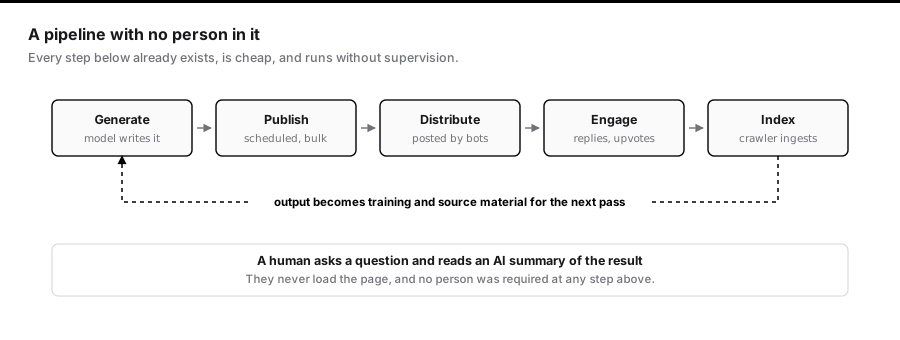
Nobody involved in most of that process had to be a real person.
That sounds like science fiction.
It also sounds increasingly normal.
Are We Still Talking to People?
One of the weirdest things about modern social media is that you often don't know.
That funny reply under a viral post?
Could be AI.
That person agreeing with you?
Could be a bot.
That angry comment trying to start an argument?
Also possibly a bot.
Even the profile picture isn't proof anymore.
We're reaching a point where simply seeing text written in a natural way doesn't tell us much.
For most of the internet's history, writing something convincingly human required a human.
That assumption is disappearing.
The Dead Internet Theory Is Still a Theory
Let's be clear about something.
The extreme version of the Dead Internet Theory—that almost everything online is fake and controlled by bots—isn't something we should blindly believe.
There are still billions of real people using the internet every day.
People are making things. Arguing. Sharing photos. Writing terrible opinions in comment sections. Creating websites nobody visits. Building projects at 2 AM because they thought of something interesting.
The internet is very much alive.
But maybe that's not the point anymore.
Maybe the more interesting question is:
How much artificial noise can the internet handle before finding real people becomes difficult?
The Value of Something Real
There's a reason small communities are becoming more appealing.
Private Discord servers. Smaller forums. Newsletters. Personal websites. Communities where you actually recognise the people posting.
When everything can be generated instantly, human effort becomes noticeable again.
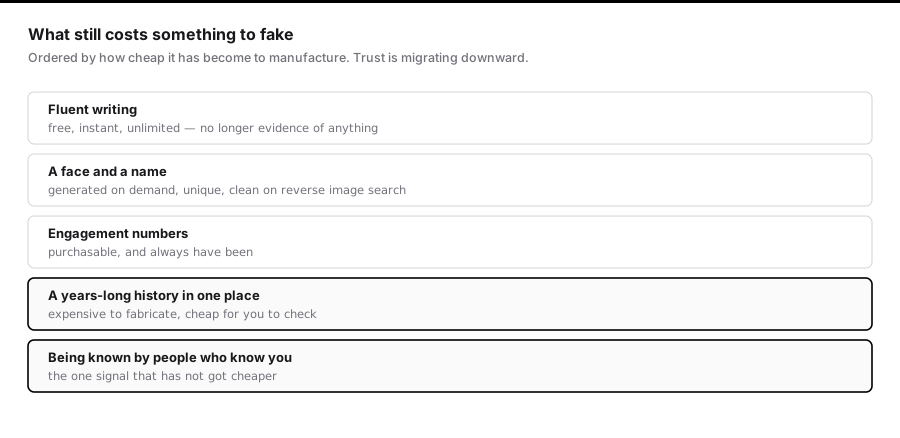
A messy article written from real experience might become more valuable than a perfectly optimized AI-generated guide.
A photo that hasn't been polished to perfection might feel more trustworthy.
A website built by one person experimenting with something might be more interesting than another company publishing 500 SEO articles generated overnight.
Maybe the future of the internet isn't about escaping AI.
That's probably impossible anyway.
Maybe it's about becoming more intentional about where we spend our attention.
So, Is the Internet Dead?
No.
But parts of it are starting to feel automated.
We're entering an era where content can exist without a person behind it. Conversations can happen without anyone actually having a conversation. Websites can publish thousands of pages without anyone writing them.
That should probably make us a little uncomfortable.
The Dead Internet Theory might still be a conspiracy theory.
But in 2026, it doesn't sound quite as ridiculous as it used to.
And perhaps the weirdest part is this:
If you read this article and wondered whether a human wrote it, you're already seeing the problem.