
World of Warcraft Private Servers Are Under Attack: What Happens When Fan-Made Azeroth Disappears?

For years, players have kept older and alternative versions of Azeroth alive outside Blizzard's official servers. But how long can those worlds survive?
For years, a shadow ecosystem has thrived alongside the official realms of World of Warcraft.
Unofficial servers. Fan-run communities. Older versions of Azeroth. Custom gameplay. Entire experiences built around versions of the game that Blizzard itself no longer operates in exactly the same way.
These are World of Warcraft private servers.
To Blizzard, they can represent unauthorized use of its intellectual property. To many players, they represent something else entirely: nostalgia, experimentation, community, and in some cases, digital preservation.
But that ecosystem has always existed under a legal cloud.
As pressure on unofficial projects continues, the future of private servers raises a much bigger question:
What happens when the people preserving a digital world don't legally own it?
And perhaps more importantly, what disappears when the servers keeping that world alive are forced offline?
The Short Version
                     WORLD OF WARCRAFT
                            │
             ┌──────────────┴──────────────┐
             │                             │
             ▼                             ▼
      OFFICIAL SERVERS               PRIVATE SERVERS
             │                             │
             │                             ├── Older versions
             │                             ├── Custom gameplay
             │                             ├── Modified progression
             │                             └── Community projects
             │
             ▼
      Blizzard controls
      the official experience
The private server debate sits at the intersection of several increasingly important issues:
- Intellectual property
- Fan communities
- Digital preservation
- Corporate control
- Gaming history
- Online-only games
And World of Warcraft has become one of the clearest examples of that conflict.
What Are World of Warcraft Private Servers?
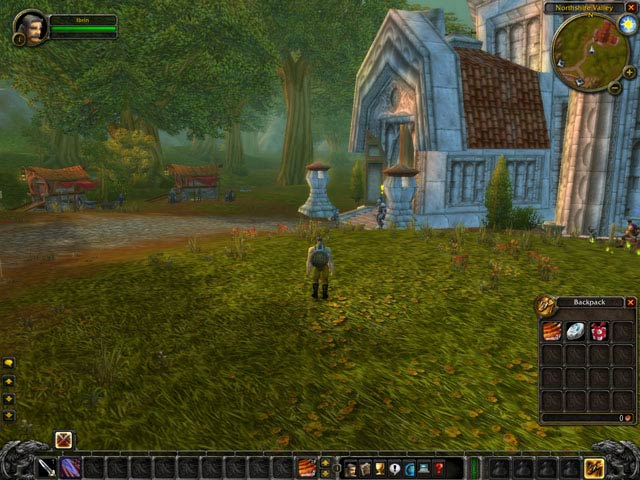
Gameplay screenshot. Image source
World of Warcraft private servers are unofficial, independently operated servers that attempt to recreate or modify World of Warcraft experiences outside Blizzard's official infrastructure.
Their appeal isn't limited to one thing.
Some players want to experience older versions of the game. Others want radically different gameplay. Some prefer faster progression, while others want to revisit a version of Azeroth they remember from years ago.
Common Types of Private Servers
| Type | What It Offers |
|---|---|
| Legacy Servers | Older versions of World of Warcraft |
| Vanilla Servers | Pre-expansion gameplay experiences |
| Custom Servers | Modified systems and mechanics |
| Vanilla+ Servers | Classic gameplay with additional features |
| High-Rate Servers | Faster progression |
| Community Projects | Experimental gameplay experiences |
The important thing is that these communities aren't all trying to achieve the same thing.
They represent hundreds of different interpretations of what World of Warcraft could be.
Why Players Keep Coming Back

Vanilla-era World of Warcraft gameplay. Image source
For many players, private servers provide something increasingly difficult to find in modern live-service games:
A fixed moment in time.
World of Warcraft has changed constantly over the years.
Expansions changed the world. Systems were redesigned. Mechanics evolved. Content was removed, altered or replaced.
A private server can effectively become a digital snapshot of a particular era.
ORIGINAL EXPERIENCE
        │
        ▼
GAME UPDATES OVER TIME
        │
        ▼
SYSTEMS CHANGE
CONTENT CHANGES
WORLD CHANGES
        │
        ▼
ORIGINAL VERSION DISAPPEARS
        │
        ▼
PRIVATE COMMUNITY
TRIES TO PRESERVE IT
That's why the debate around private servers is more complicated than simply saying:
"People are playing a game without paying."
For many players, the experience they want may simply no longer exist in the same form on the official game.
The Technical Ecosystem Behind Private Servers

The private-server ecosystem also includes open-source emulation projects such as AzerothCore.
Private servers don't simply appear because someone presses a button.
Behind many projects are communities of developers and administrators working on complicated technical systems.
These projects can involve:
- Server emulation
- Networking
- Databases
- Bug fixing
- Game scripting
- Quest systems
- Player data
- Community management
GAME KNOWLEDGE
      +
PROGRAMMING
      +
NETWORKING
      +
DATABASES
      +
COMMUNITY WORK
      │
      ▼
PRIVATE SERVER PROJECT
For some contributors, these projects are also learning environments.
Years can be spent recreating mechanics, fixing bugs and attempting to reproduce the behaviour of older versions of the game.
That means a server shutdown can destroy more than player access.
It can also fragment communities and erase years of collaborative work.
Blizzard's Legal Battle for Intellectual Property
Blizzard's position is also understandable.
World of Warcraft's code, art, characters, worlds and other assets are Blizzard's intellectual property.
From the company's perspective, unauthorized services using or reproducing that material can constitute copyright infringement and other legal violations.
The typical escalation looks something like this:
UNOFFICIAL PROJECT
        │
        ▼
LEGAL NOTICE
        │
        ▼
CEASE-AND-DESIST
        │
        ▼
SERVER SHUTDOWN
        │
        ▼
POSSIBLE LITIGATION
Fan passion doesn't automatically override copyright law.
That creates one of the most difficult conflicts surrounding game preservation.
The people most passionate about preserving a game are often the people who have the least legal control over it.
The Nostalrius Effect

An archived Nostalrius community screenshot. Original community post
The shutdown of Nostalrius became one of the defining moments in the history of World of Warcraft private servers.
Nostalrius ran a recreation of World of Warcraft's pre-expansion era and attracted an enormous community.
The project became especially notable because of the scale of the player response after it shut down.
NOSTALRIUS
    │
    ▼
MASSIVE LEGACY COMMUNITY
    │
    ▼
LEGAL PRESSURE
    │
    ▼
SERVER SHUTDOWN
    │
    ▼
MASSIVE PLAYER REACTION
    │
    ▼
DEMAND FOR OFFICIAL
LEGACY SERVERS
The response went far beyond the immediate player base.
A petition calling for official legacy servers attracted hundreds of thousands of signatures, and Blizzard eventually agreed to meet with representatives of the Nostalrius team.
That made Nostalrius something bigger than just another private server shutdown.
It became proof that there was a significant audience interested in older versions of World of Warcraft.
Further Reading
- Nostalrius community archive
- Ars Technica: Blizzard shuts down popular fan-run server
- Ars Technica: Blizzard agrees to meet with Nostalrius representatives
- Legacy server petition
The Classic Compromise

World of Warcraft Classic gave players an official way to revisit an earlier era of the game.
Blizzard eventually launched World of Warcraft Classic in 2019.
The official project gave players a legitimate, officially supported way to revisit early versions of Azeroth.
PLAYERS WANT
OLDER WOW
        │
        ▼
PRIVATE SERVERS GROW
        │
        ▼
DEMAND BECOMES VISIBLE
        │
        ▼
BLIZZARD LAUNCHES
WOW CLASSIC
        │
        ▼
OFFICIAL LEGACY EXPERIENCE
WoW Classic didn't eliminate interest in private servers.
Private communities still offer custom systems and alternative experiences that official servers don't.
But Classic demonstrated something important:
The demand for older World of Warcraft experiences was real.
Official Links
- World of Warcraft Classic Is Now Live
- World of Warcraft Classic FAQ
- Restoring History: Creating WoW Classic
Private Servers Aren't Just About Nostalgia
One reason private servers remain relevant is that some aren't trying to recreate Blizzard's original game exactly.
They're trying to change it.
Project Ascension
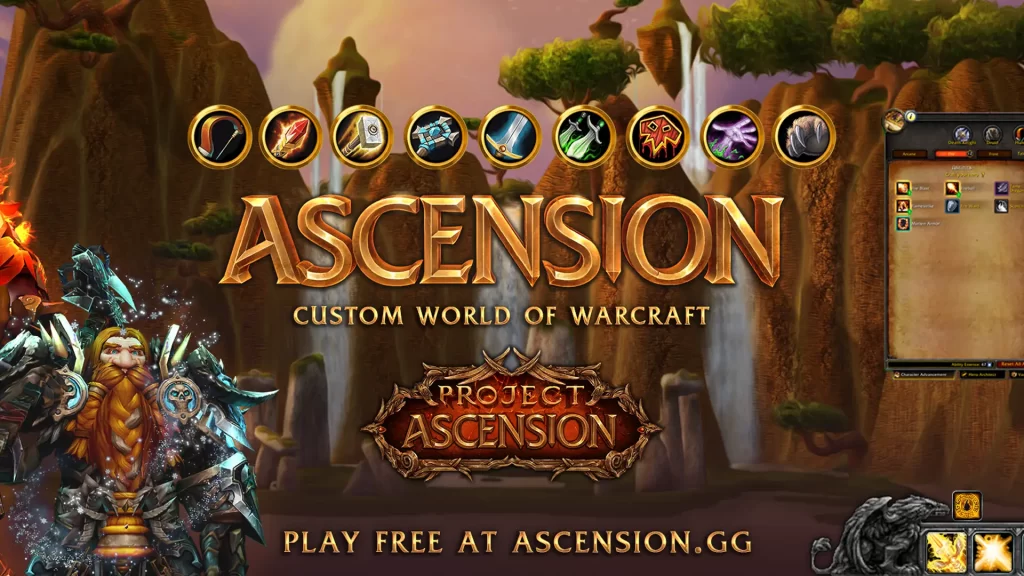
Project Ascension is an example of a custom World of Warcraft experience with heavily modified gameplay.
Projects such as Project Ascension demonstrate another side of the private server ecosystem.
Instead of simply recreating old World of Warcraft, custom projects can experiment with entirely different gameplay structures.
These communities can introduce ideas such as:
- Classless systems
- Custom abilities
- Modified progression
- Alternative character builds
- Experimental gameplay mechanics
OFFICIAL WOW
     │
     ▼
FIXED GAME DESIGN


CUSTOM PRIVATE PROJECT
     │
     ├──► New Systems
     ├──► New Progression
     ├──► Custom Abilities
     └──► Community Experiments
This is one reason the private server conversation can't be reduced entirely to nostalgia.
Some communities aren't trying to go backwards.
They're trying to see where the game could go next.
Who Owns Digital History?
The World of Warcraft debate becomes even more interesting when viewed as part of a larger problem.
Modern games increasingly depend on online infrastructure.
GAME
 │
 ▼
ONLINE SERVERS REQUIRED
 │
 ▼
COMPANY CONTROLS ACCESS
 │
 ▼
SERVERS SHUT DOWN
 │
 ▼
OFFICIAL GAME DISAPPEARS
 │
 ▼
COMMUNITY TRIES TO PRESERVE IT
 │
 ▼
LEGAL CONFLICT
A physical game can survive for decades.
An online-only game may disappear the moment its servers shut down.
This creates a difficult question for the future of gaming.
If a company stops supporting a game, who—if anyone—should be allowed to preserve it?
The company?
Museums?
Archivists?
Fans?
Nobody?
The law and the technology haven't always evolved at the same speed.
What Gets Lost When a Private Server Disappears?
A server shutdown doesn't only mean players lose a login screen.
It can mean the disappearance of:
- Player communities
- Guild history
- Custom development
- Technical knowledge
- Community events
- Modified game experiences
- Years of player-created memories
SERVER SHUTDOWN
      │
      ├──► GAME ACCESS LOST
      │
      ├──► COMMUNITY FRAGMENTED
      │
      ├──► CUSTOM DEVELOPMENT LOST
      │
      └──► DIGITAL HISTORY DISAPPEARS
An online world isn't just software.
It's also the people who spent thousands of hours inside it.
Guilds.
Friendships.
Rivalries.
Communities.
Stories.
That is why these shutdowns can generate such strong reactions.
The Future of Fan-Made Game Worlds
The conflict between publishers and private communities isn't going away.
If anything, the growth of online-only games may make it increasingly common.
                 THE COMPANY
                      │
                      ▼
             PROTECTS ITS IP
                      │
                      │
              ───── CONFLICT ─────
                      │
                      │
                      ▼
                THE COMMUNITY
                      │
                      ▼
             PRESERVES THE GAME
Both sides have understandable interests.
Companies have the right to protect their intellectual property.
Players have legitimate concerns about games and experiences disappearing from history.
The challenge is finding a future where preservation doesn't always require a direct conflict with ownership.
Final Thoughts
World of Warcraft private servers exist because players wanted things the official game didn't always provide.
A specific version of Azeroth.
Different gameplay.
Custom mechanics.
A community-driven experience.
Or simply a chance to return to the World of Warcraft they remember.
Blizzard has legitimate reasons to defend its intellectual property.
But private server communities represent something larger than unauthorized infrastructure.
They expose a growing problem in digital entertainment.
What happens to a digital world when the people who love it most are legally unable to preserve it?
World of Warcraft is just one example.
As games become increasingly dependent on servers, subscriptions and corporate infrastructure, the same question will eventually affect far more than Azeroth.
GAMES BECOME DIGITAL
        │
        ▼
SERVERS BECOME ESSENTIAL
        │
        ▼
COMPANIES CONTROL ACCESS
        │
        ▼
GAMES CAN DISAPPEAR
        │
        ▼
COMMUNITIES TRY TO PRESERVE THEM
        │
        ▼
THE LEGAL BATTLE BEGINS
Eventually, the argument won't just be about World of Warcraft.
It could be about every digital world we've ever loved.